How It Works · AI-native Integrity OS
Equipmate is the vendor-neutral intelligence layer that reads across your OT and IT, builds one canonical integrity model, and turns it into prioritized, defensible action — starting with corrosion. Here is exactly how it works on your data, in your tenant.
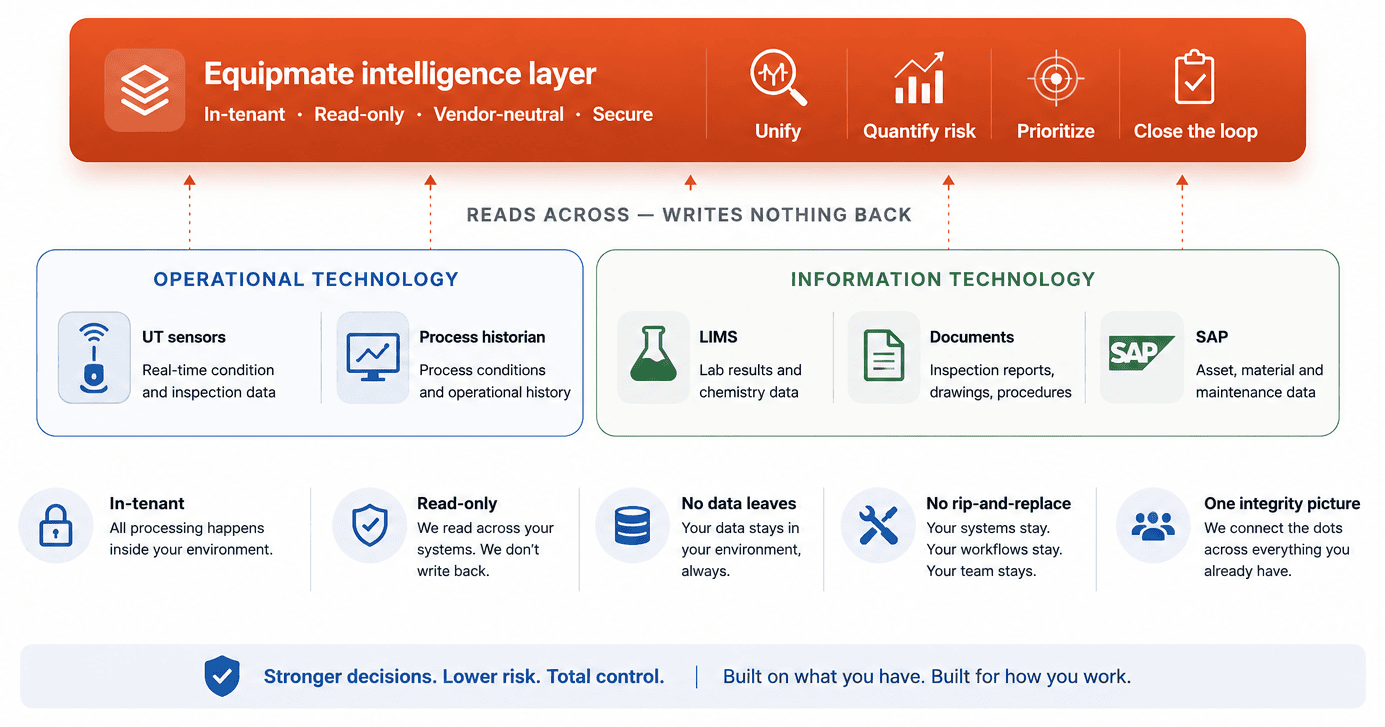
Equipmate is an intelligence layer, not another system of record. It sits above your existing OT and IT — sensors, the process historian, LIMS, documents and SAP — reads across them, and leaves them exactly where they are.
Everything runs in-tenant and read-only. No data leaves your environment, nothing is ripped out, and the engineers keep working in the tools they already trust. We turn what's already there into one integrity picture.
The same four steps run on every corrosion loop and asset — from raw OT and IT signals to a prioritized, defensible action your team can act on today.
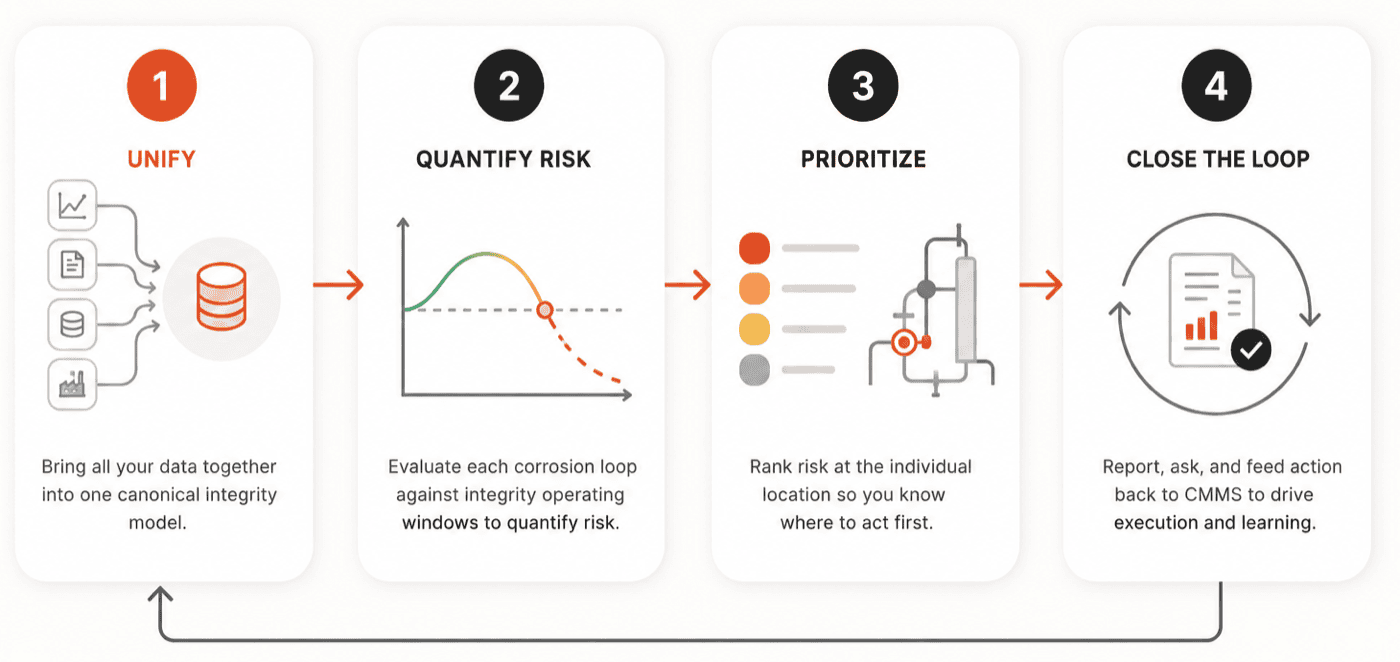
Read across OT — UT sensors and the process historian — and IT — LIMS, inspection documents and SAP — into a single canonical integrity model. It runs in-tenant and read-only, so nothing leaves your environment and nothing is overwritten.
Every corrosion loop and asset is evaluated against its integrity operating windows (IOW) — computing corrosion rate, remaining life, and the governing damage mechanism per API 571. Excursions and accelerating wall loss surface as quantified, traceable risk rather than a buried trend line.
Risk is ranked at the individual location and condition-monitoring point — not as a program-wide or circuit-wide average that hides the one spot that's actually degrading. Your team sees exactly where to inspect and intervene first, and why.
Equipmate drafts the integrity report with its full evidence trail, answers questions in plain language through a natural-language "Ask," and feeds the resulting action back into your CMMS — so a quantified risk becomes a scheduled, tracked, auditable job.
Request a technical briefing, or apply for the pilot program — and see Equipmate on your data in weeks, not years.